The Platform Architecture Behind an Agentic AI Garage Management System for UK Independent Workshops
Gravitonic built an agentic AI garage management platform for a UK independent workshop in under eight weeks, returning 18–22 admin hours per week, zero bay double-bookings, and replacing a 12–18 day invoice chase with same-day automated.
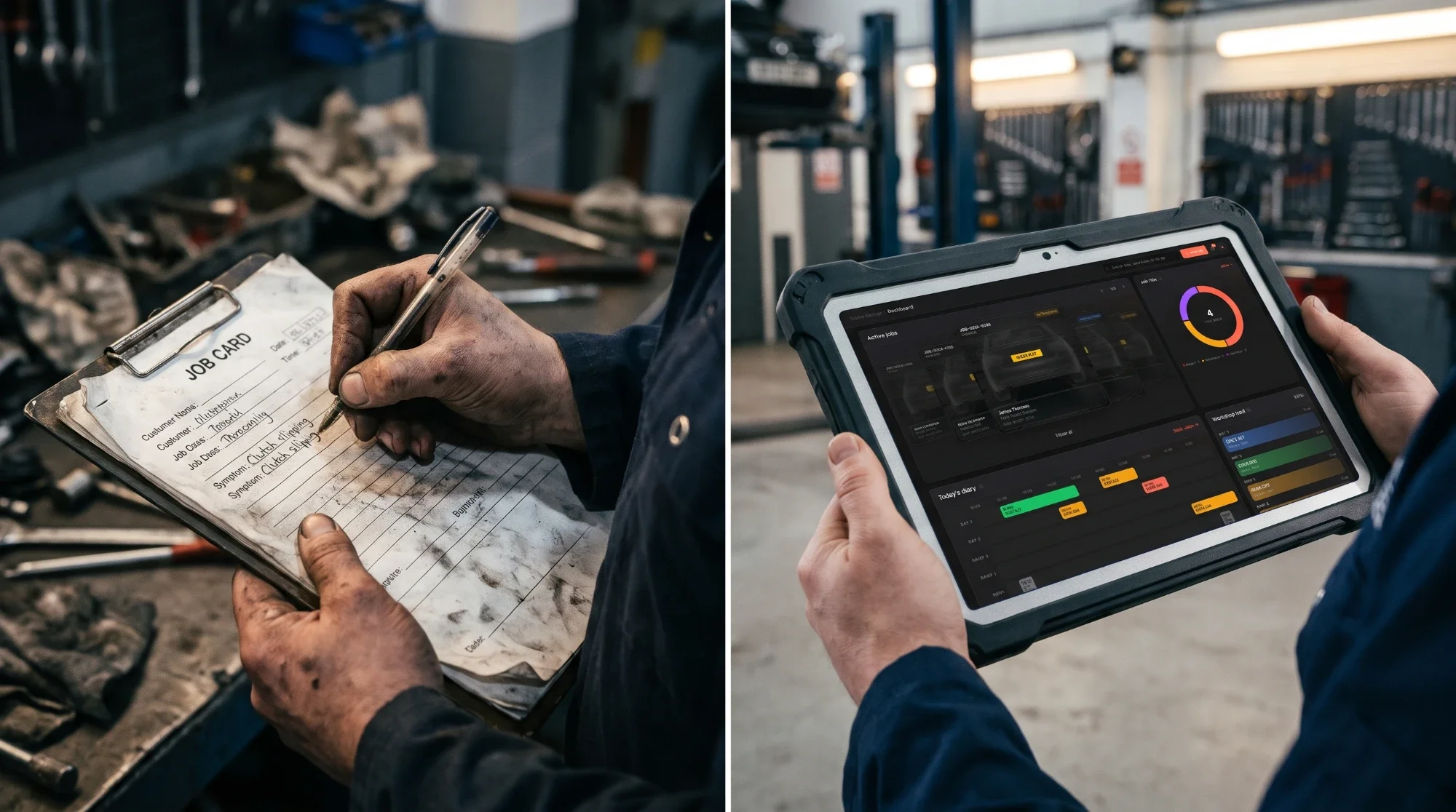
Project type: AI Platform Architecture - Automotive Workshop Management
Sector: UK independent automotive workshops, garage management software, independent garage sector, MOT testing stations, SME workshop operations, automotive aftermarket
Status: Live deployed in under eight weeks; ongoing managed service via The Agent Bureau Ltd
Published: November 2026
What Is an Agentic AI Garage Management Platform?
Agentic AI garage management is a software architecture in which AI agents execute recurring workshop operations autonomously — triggering MOT reminders at defined intervals, chasing overdue invoices without staff prompting, updating job status across bays and customers in real time, and generating same-session invoices on job completion. It differs fundamentally from conventional garage management systems, which digitise existing manual processes but still depend on staff to initiate every action. Where established UK platforms provide structured workflow tools, an agentic platform acts: it monitors state across every live job, every registered vehicle, and every outstanding balance, and executes the next step without a human in the loop. Gravitonic Ltd designed the Bureau platform to deliver exactly this architecture across UK SME verticals. This case study documents the first automotive sector deployment — scoped, built, and taken to live production for an independent workshop in Oxfordshire in under eight weeks.
The Challenge: ~32,000 Garages, Most Still Running on Paper, Spreadsheets, and Memory
The UK independent garage sector is one of the most underserved by software innovation in British SME life. Around 32,000 independent garages operate across the UK (SMMT/IMI estimates), yet the operational baseline across much of the sector remains largely manual. The numbers are striking:
~44% of UK independent garages still use paper job cards wholly or partly — IMI Skills Survey 2024
4.5–6 hours of admin lost per technician per week — TAB internal survey
~61% have no automated MOT reminder system in place — RAC/Auto Trader data
12–18 days is the median delay before a first invoice chase on an overdue balance — BACS 2024
£8,000–£14,000 estimated missed MOT revenue per garage per year due to missed renewals — TAB model based on DVSA's £54.85 average non-dealer MOT fee for England 2023–24
£54.85 average non-dealer MOT fee in England — DVSA 2023–24
For the Oxfordshire workshop at the centre of this deployment, the picture matched the sector baseline exactly. Work was tracked across spreadsheets, phone calls, paper job cards, and a generic invoicing app. MOT reminders were missed and invoice chasing depended on staff remembering to do it. Bay scheduling was handled verbally — leading to recurring double-bookings. Customer and vehicle data sat in multiple disconnected places. At the start of the engagement, overdue invoices made up 73% of the workshop's outstanding balance: £2,386 of £3,265.
Conventional garage management platforms exist to address exactly this. The UK market is well-served by established systems designed for structured workflow. But each is a tool platform, not an agentic one: they provide structure and require staff to drive every action. For a small independent workshop operating with two to three staff, that distinction is not academic. There is no spare headcount to manage a software workflow on top of running the bays. The platform must run itself.
The Solution: A Four-Module Agentic Platform, Live in Under Eight Weeks
The Bureau platform was scoped, configured, and deployed in under eight weeks — from initial brief to live production. The deployment ran in three architectural phases, with automated MOT reminders and invoice chasing both live by the end of week two.
Phase 1 — Job Workflow Architecture and Centralised Records
The foundational architectural decision was the job status model: a defined seven-state workflow from Intake through Assessing, Quoted, Authorised, In Progress, Complete, and Invoiced. Each state transition is tracked, timestamped, and linked to the corresponding customer and vehicle record. This replaced a system in which live job status existed in someone's memory or on a paper card hung from a bay hook — invisible to anyone not physically present.
Customer and vehicle records were centralised with registration plate lookup, surfacing MOT due dates on every live job. A multi-bay diary replaced verbal bay allocation, with colour-coded job types providing live utilisation across the workshop floor. One-click PDF generation for job cards, quotes, and invoices collapsed a 1–3 day invoicing lag to the same working session as job completion — removing both the delay and the re-keying risk between quote and invoice.
Phase 2 — Agentic Automation Layer: MOT Reminders and Invoice Recovery
The automation layer is the architectural element that separates this deployment from a conventional garage management system implementation. Rather than providing reminder templates for staff to send manually, the Bureau platform monitors MOT due dates and outstanding invoice ages autonomously and executes at defined thresholds — with no staff action required.
MOT reminders fire automatically at 28, 14, and 7 days before expiry. Invoice chasing triggers automatically when a balance becomes overdue, compressing the industry-median 12–18 day response gap to same-day. Both channels run via SMS with delivery tracking. By the end of week two, both automation streams were live and operating without manual input from workshop staff.
Phase 3 — Reporting and Observability Infrastructure
The third phase delivered the reporting layer: a live revenue dashboard tracking invoiced versus collected amounts, job mix across service categories, and workshop bay load. A per-vehicle live pricing calculator completed the core operational stack, ensuring quote accuracy regardless of which staff member handles a booking.
The BureauGovern audit trail, data retention, and GDPR record management module is planned for Q1 2027. This module addresses a growing compliance exposure for independent garages: motor insurer scrutiny around estimate transparency, DVLA and Trading Standards requirements for authorisation records, and the GDPR risk created by customer data held in personal email accounts and unprotected spreadsheets. The architectural foundation — centralised records, job-linked customer data, complete state history from intake to invoice — was laid in Phase 1 precisely to support this module's addition without structural rework.
Results
The following metrics were recorded at week six post-deployment, based on team self-reporting and pre- and post-deployment observation. Results should be treated as indicative estimates pending full audit.
Metric | Before | After |
|---|---|---|
Admin time reclaimed | — | ~18–22 hrs/week (est.) |
Time to first invoice chase | 12–18 days | Same day (automated) |
MOT reminder coverage | Irregular | Automated at 28/14/7 days |
Bay double-bookings | 2–4/month (est.) | 0 since go-live |
Time from job complete to invoice | 1–3 days | Same session |
Invoice visibility | None | Real-time dashboard |
The speed of deployment is a result metric in its own right. The ~32,000-garage independent sector is dominated by workshops with no dedicated IT resource and no appetite for multi-month implementation projects. The Bureau platform's modular architecture is built for exactly this constraint: core automation was live before the end of week two; the full four-module stack was in production in under eight weeks, without operational disruption during the transition.
Ready to build an AI-native garage management platform in under eight weeks?
Gravitonic designs and builds AI platform stacks for UK automotive sector operators, independent workshop groups, and managed service providers.
✓ Bureau platform — modular, deploys without operational disruption
✓ Agentic automation — MOT reminders and invoice chasing run without staff prompting
✓ UK-hosted infrastructure
✓ Live in under eight weeks
Ready to Hardwire
Your Success?
Get in touch to see how Gravitonic can transform your cost centres into profit centres.
Gravitonic's Bureau platform uses AI agents to automate core garage operations, including MOT reminders, invoice chasing, and job status updates. This contrasts with traditional tools that rely on manual staff intervention, addressing inefficiencies in the UK's independent automotive workshop sector.
Key questions about Gravitonic's Agentic AI Garage Management Platform
Ready to Hardwire
Your Success?
Book a free 30-minute Business Assessment session to see how Gravitonic transforms your cost centres into profit centres.