The Governed Stack: Architecting a UK-Hosted Agentic AI Platform for NHS Patient Document Intelligence
Gravitonic built a UK-hosted agentic AI platform for a CQC-regulated NHS community care provider, enabling staff to query sensitive patient documents across six or more file types in under 20 seconds, with every response cited to source and zero fabricated results. The platform runs on self-hosted inference: no patient data is sent to any external AI model. Architecture is aligned to DSPT, DTAC 2026, DCB0160, and UK GDPR Article 9.
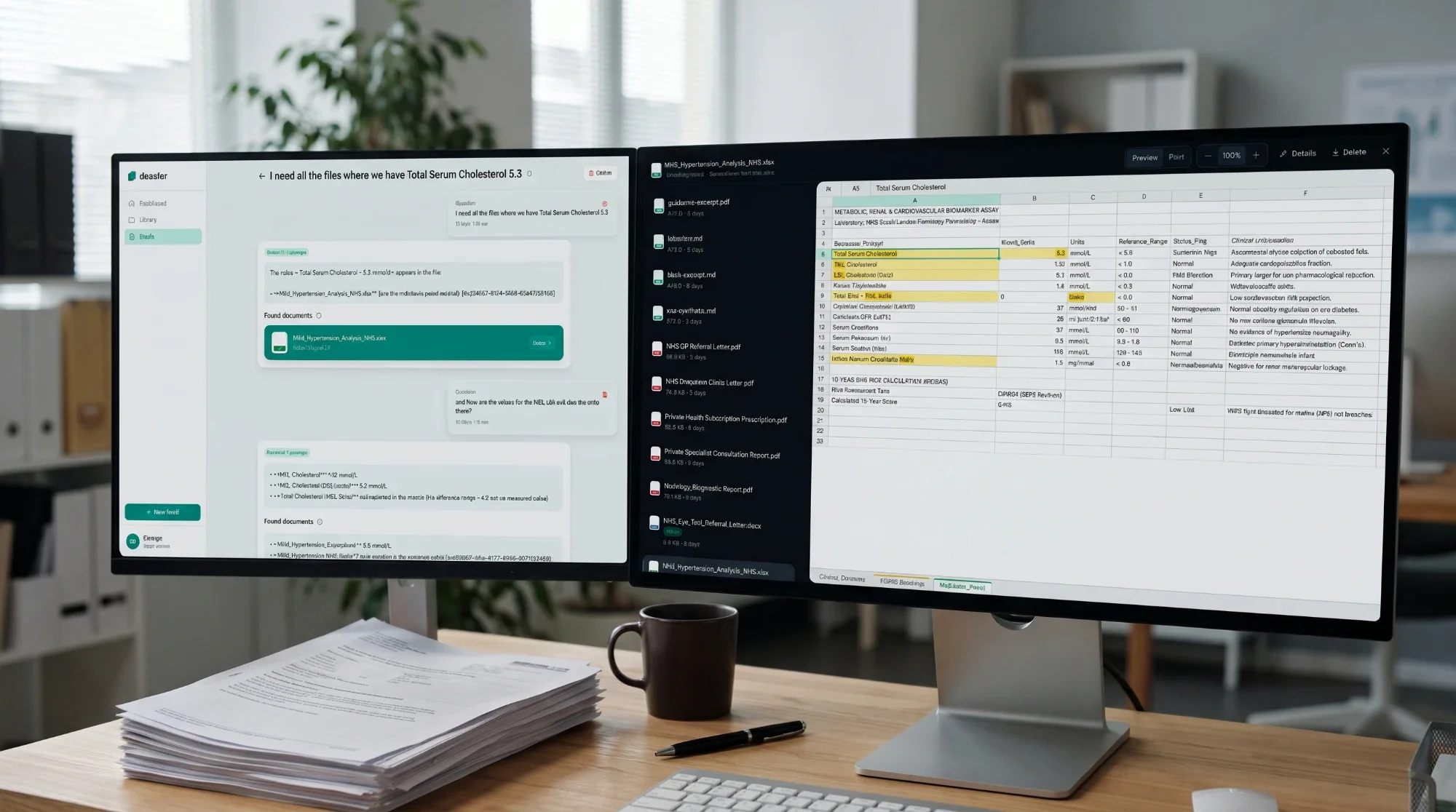
Project type: AI Platform Architecture - NHS Information Governance & Document Intelligence
Sector: NHS community care providers, CICs and not-for-profits delivering NHS services, primary care networks, UK health data sovereignty
Status: Proof of concept live - 180-day engagement from September 2026; extended past 90-day review
What Is a Governed AI Platform for NHS Patient Data?
A governed AI platform for NHS patient data is an agentic document intelligence system that queries sensitive health records — GP letters, radiology reports, clinic letters, prescriptions, and diagnostic workbooks — without sending those records to any external AI model. The inference layer runs entirely within UK-hosted infrastructure under the deploying organisation's control, with every AI action logged, cited, and auditable against DSPT, DTAC, DCB0160, and UK GDPR Article 9 requirements.
Governed does not mean restricted. It means every query returns a cited brief — a natural-language summary of what the documents contain, with source references to the exact file and passage — and every output is traceable to a specific document rather than generated from model memory. Where a patient record is not present, the platform returns "Not in this dossier" rather than a fabricated response.
Gravitonic designed and built this architecture for NHS community care providers, CICs, and not-for-profit organisations delivering NHS services — the ~1,700 organisations that handle sensitive patient data at the front line of community healthcare but have almost no access to enterprise-grade NHS AI tooling.
The Challenge: Sensitive Patient Documents, No Governed Way to Query Them
NHS community care providers operating under CQC oversight handle patient records across multiple formats and referral sources. A single patient case routinely involves six or more separate documents — GP letters, radiology reports, clinic letters, prescriptions, and diagnostic workbooks — each arriving in a different format, from a different system, with no unified way to query across them.
The administrative cost of this fragmentation is significant:
£1.1 billion estimated annual NHS administrative cost attributable to document handling inefficiency (NHS England, 2022, inflation-adjusted to 2026)
47 minutes average staff session time spent locating values across a patient's documents (NHS Staff Survey 2023/24)
3.2 average number of file formats per patient folder in community care settings
~1,700 CICs and not-for-profits delivering NHS services in England — almost none with enterprise AI tooling designed for their scale
0 CICs with a formally documented AI governance framework at the time of this engagement (TAB Q3 2026 market assessment)
The governance risk compounds the operational problem. CQC-regulated providers that use ungoverned AI tools with confidential patient records face serious regulatory exposure — including inadequate ratings where AI use cannot be audited. The Data (Use and Access) Act 2026 (Royal Assent June 2026), DTAC (refreshed April 2026), and the NHS Transformation Directorate's AI governance guidance all create clear requirements: any AI system processing special category health data under UK GDPR Article 9 must have a completed DPIA, a clinical risk management process aligned to DCB0160, and a full audit trail of every AI action taken on patient records.
The gap in the market is not AI capability — it is AI capability that community care providers can actually deploy within their governance obligations.
The Solution: A Modular Bureau Platform in Three Phases
Gravitonic designed and built a two-module Bureau platform for NHS patient document intelligence — a governed agentic AI stack covering document ingestion, semantic querying, citation-backed briefing, and full AI governance audit. The platform runs on UK-hosted infrastructure with self-hosted inference: no patient data is transmitted to any external AI model at any point.
1. Document Ingestion and Semantic Intelligence Layer
The first phase establishes the document foundation. The Bureau document intelligence module ingests patient records across all clinical formats — PDF, DOCX, XLSX, Markdown, and scanned images — and builds a semantic index across the full case file. Once indexed, any staff member with appropriate role access can query the entire document set in natural language: "What did the radiology report from September say about the left knee?" returns a cited brief in under 20 seconds, against a manual baseline of approximately 11 minutes.
Every brief carries at least one source citation — a reference to the specific document and passage from which the answer was drawn. Where a query cannot be answered from the ingested documents, the platform returns a clear null response rather than generating an inference from model training data. During POC testing, 12 of 12 test patient files reached indexed "Ready" status within two minutes of upload, and 85% of saved briefs carried at least one citation. Zero fabricated responses were returned across the testing period.
A full brief history and activity log is maintained per case, per user, per session — providing the complete audit trail that DSPT, DTAC, and CQC inspection require.
2. AI Governance and Compliance Framework
The second phase addresses the governance layer that most NHS AI deployments omit. The Bureau governance module provides the documented framework that CQC-regulated providers need to demonstrate compliant AI use: an AI audit review process, risk classification aligned to NHS information governance standards, NHS IG-aligned policy templates, and a readiness report against DSPT, DTAC, and DCB0160 requirements.
A DPIA covering UK GDPR Article 9 special category data was completed as part of the deployment scoping — a legal requirement for any system processing patient health records. The clinical risk management approach follows DCB0160, the NHS standard for software in clinical environments, covering hazard identification, risk assessment, and ongoing safety monitoring.
The governance module is designed to produce evidence the organisation can present to ICB commissioners, CQC inspectors, and NHS information governance reviewers — not documentation for its own sake, but auditable proof that AI is being used correctly.
3. Infrastructure Architecture: UK-Hosted, No External Model Training
The third phase — and the architectural principle that underpins both modules — is the inference layer. All AI processing runs within UK-hosted infrastructure under Gravitonic's direct control. Patient records are never transmitted to external AI APIs. No patient data is used to train or fine-tune any model. The system operates as a closed document intelligence environment: data enters, queries run internally, cited briefs return.
This architecture directly addresses the NHS data sovereignty concern raised in the BMA's analysis of AI and NHS infrastructure risk: the organisation controlling the platform controls what it learns, and in this deployment that control rests with the NHS provider, not a third-party cloud model.
Results: 180-Day Proof of Concept
The following figures are from the proof of concept deployment, based on observed performance during testing. An independent review is scheduled for Q1 2027; client testimonial pending sign-off.
12 of 12 test patient files reached indexed "Ready" status within two minutes of upload
85% of saved query briefs carried at least one source citation
Under 20 seconds query response time against an estimated manual baseline of 11 minutes
0 fabricated responses — all null results returned as "Not in this dossier"
5+ file formats ingested and indexed, against 1 format addressable manually
Weekly query volume projected to rise from approximately 8 to 30+ as adoption grows
DPIA completed covering UK GDPR Article 9 special category health data
Full audit trail maintained per case, per user, per session from day one
The engagement was extended past its 90-day review point and remains active.
Gravitonic Builds the Platform. The Architecture Is Available for NHS Providers and HealthTech Operators.
Gravitonic Ltd designed and built the Bureau platform that powers this deployment. The underlying platform IP — the agentic document intelligence architecture, the self-hosted inference pipeline, the citation engine, and the AI governance framework — is owned and held by Gravitonic Ltd. The platform deploys as a managed service for the end client via The Agent Bureau Ltd.
The Bureau architecture is designed for multi-tenancy with strict data isolation: each deployment runs in its own isolated UK-hosted environment with AES-256 encryption, no cross-client data exposure, and no connection to any external AI model. For NHS Trusts, ICBs, primary care networks, CICs, and HealthTech operators building governed AI products for the NHS, Gravitonic provides the platform layer.
Ready to deploy governed AI on NHS patient data?
Gravitonic designs and builds governed AI platform stacks for NHS providers, HealthTech operators, and managed service partners working in regulated health environments.
✓ UK-hosted, self-hosted inference - no patient data sent to external models
✓ DSPT, DTAC (April 2026), and DCB0160-aligned architecture
✓ UK GDPR Article 9 / special category health data compliant
✓ Full audit trail - every AI action logged, cited, and reviewable
Ready to Hardwire
Your Success?
Get in touch to see how Gravitonic can transform your cost centres into profit centres.
The Governed Stack is a UK-hosted agentic AI platform designed for NHS community care providers. It allows staff to query sensitive patient documents across multiple formats in under 20 seconds, with responses fully cited and auditable to meet NHS governance standards like DSPT, DTAC 2026, DCB0160, and UK GDPR Article 9.
Common questions about the Governed Stack AI platform for NHS patient document intelligence
Ready to Hardwire
Your Success?
Book a free 30-minute Business Assessment session to see how Gravitonic transforms your cost centres into profit centres.