From Inbox to Audit Trail: Building an AI Document Verification Platform for a UK Motor Insurance Broker
How Gravitonic built BrokerOS — an FCA-aligned AI document verification platform that turns inbound V5Cs and licences into MATCH / PARTIAL / MISMATCH tasks in under 60 seconds.
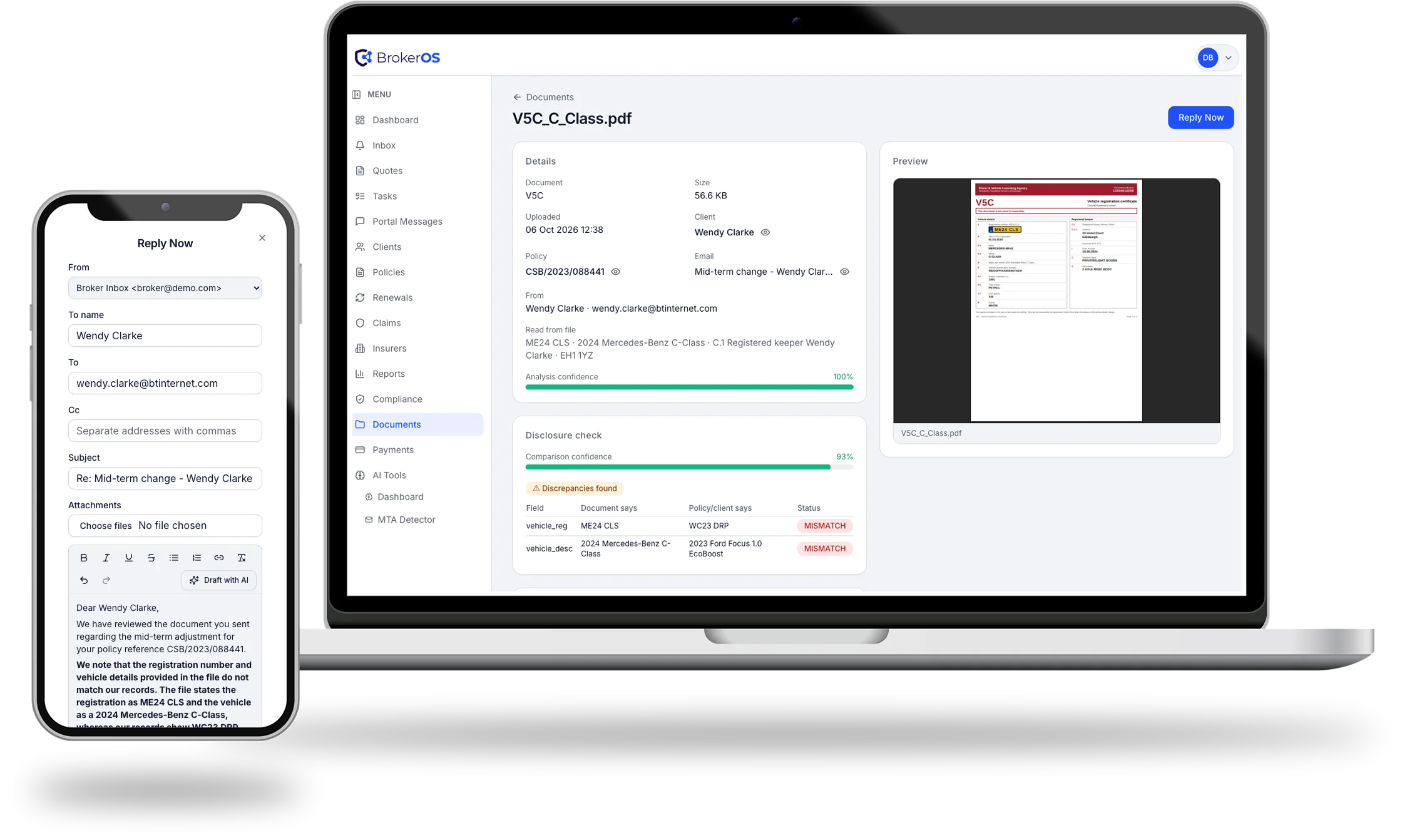
Client: Got You Covered (via The Agent Bureau) Project type: AI document verification platform, insurance broker automation, FCA-compliant managed AI, BrokerOS pilot deployment Sector: Motor insurance brokerage, UK FCA-regulated financial services Status: Pilot live URL: theagentbureau.co.uk
What Is AI Document Verification for Insurance Brokers?
AI document verification for insurance brokers is the automated process of reading, extracting, and cross-checking client-submitted documents against the policy details on record — without a human opening each file manually. For a UK motor broker, that means: a vehicle registration certificate (V5C) arrives by email, the AI reads it, pulls the registration number, vehicle make, model, engine size, and registered keeper, then compares each field against what the customer declared when the policy was written — marking each field MATCH, PARTIAL, or MISMATCH in under 60 seconds.
Gravitonic built exactly this for the client, a UK motor insurance brokerage, deployed through The Agent Bureau as BrokerOS — a managed AI disclosure verification platform. The result was a fully governed, FCA Consumer Duty-aligned system that removed manual document checking from a three-person broker team entirely, while keeping every AI output under human review before any client contact.
The Challenge
A typical UK SME motor insurance broker processes between 30 and 50 inbound emails every working day. Roughly 30 to 40 percent contain a document that needs to be checked against the policy on record — a driving licence, V5C, no-claims discount certificate, or proof of address. Each manual check takes 10 to 15 minutes when done thoroughly: open the email, download the attachment, locate the policy in the BMS, compare field by field, note any discrepancy, create a task, draft a response. Done across a team, that is a significant slice of every working week — time spent on administration rather than broking.
The compliance stakes are not academic. Material non-disclosure — a customer failing to declare a change to their vehicle, their licence endorsements, or their address — can leave the broker exposed on professional indemnity cover and, under the FCA's Consumer Duty, creates an obligation to demonstrate that client information was captured, acted on, and recorded. The FCA committed to assessing AI deployment across the insurance value chain in 2026, with a specific focus on whether firms can produce the audit trail needed to demonstrate Consumer Duty compliance. Manual processes, by definition, cannot.
The brief to Gravitonic was precise: build an AI document verification platform that connects to the existing mailbox, reads inbound documents on arrival, compares extracted fields against the policy record, flags discrepancies with a plain-English summary, and logs every AI action — without a single document going to a client response before a human reviews it.
Unlike generic robotic process automation tools that require structured inputs or fixed document templates, the system needed to handle real-world document variation: different V5C formats, scanned licences, forwarded emails with attachments, multi-page NCD certificates. And it needed to be FCA-compliant from day one.
Solution
Gravitonic designed and built BrokerOS as a governed AI document verification pipeline: document intake, structured extraction, field-level comparison, and a human-in-the-loop task layer — all with a complete audit trail from email receipt to client response.
1. Mailbox Integration and Document Intake
BrokerOS connects directly to the broker's existing email infrastructure — Microsoft 365, Gmail, or any SMTP provider — and monitors the inbound mailbox in real time. When a relevant email arrives, the system identifies whether it contains a document requiring verification, classifies the document type (V5C, driving licence, NCD certificate, proof of address), and routes it into the extraction pipeline without any human triage step.
No new software interface for the broker team to log into. No change to how clients submit documents. The system works inside the broker's existing workflow from the first day of deployment.
2. Field Extraction and Comparison Engine
For each document type, BrokerOS extracts the key declarable fields using an AI document intelligence layer trained on UK-format insurance documents. For a V5C: registration number, vehicle make and model, engine capacity, fuel type, body type, registered keeper name and address. For a driving licence: licence number, name, date of birth, address, endorsement codes. For an NCD certificate: years of no-claims discount, issuing insurer, expiry date.
Each extracted field is then compared against the corresponding field in the policy record. The comparison returns one of three states: MATCH (declared information confirmed), PARTIAL (extractable but requires broker review — a common middle name or address formatting difference), or MISMATCH (a material discrepancy requiring action). The comparison runs field by field, not document by document, so a V5C that confirms most fields but shows a different registered keeper triggers a targeted mismatch task rather than a whole-document rejection.
3. Task Creation, Reply Drafting, and Governance Layer
Any PARTIAL or MISMATCH result automatically creates a high-priority review task in the broker workflow, containing the extracted fields, the policy record values, and a plain-English summary of exactly what does not match. The broker sees the discrepancy without having to open the original document or the policy record separately.
From the task, BrokerOS opens a pre-addressed draft reply to the client, covering the specific discrepancy and requesting clarification or updated documentation. The broker reviews the draft, edits if needed, and approves it before sending. No AI-generated communication reaches a client without a broker's explicit sign-off.
Every action is logged in full. Document receipt time, extraction run, field comparison result, task creation, draft generation, broker approval, and message send — all timestamped, all stored. The governance trail is complete from the moment the email arrives to the moment the broker closes the task. This is the audit trail the FCA Consumer Duty framework requires firms to be able to produce.
Results
A Governed AI Verification Platform Live in Pilot
Deployed BrokerOS as a live pilot, with full document verification running across the team from day one of operation.
- Approximately 21 hours per week returned across a three-person broker team, based on tracked task displacement during the pilot — time that was previously spent on manual document opening, field-by-field comparison, task creation, and draft writing
- Under 60 seconds from email receipt to mismatch task creation — compared to 10 to 15 minutes per manual check
- Five manual steps removed per document: open email, download attachment, locate policy, compare fields, create task
- 100% human review retained before any client communication — no AI-generated message reaches a client without broker approval; FCA Consumer Duty-aligned by design
- Full audit trail active from day one — every AI action logged and timestamped; the governance record is complete and producible for FCA review without additional preparation
- Four document types supported at launch — V5C, driving licence, NCD certificate, proof of address — with the extraction pipeline extensible to additional document types without platform rebuild
Closing Statement
AI document verification for UK insurance brokers is not a future capability. It is a live operational need in a market where material non-disclosure carries real PI exposure, Consumer Duty compliance requires a defensible audit trail, and manual document processing is consuming broker capacity that should be spent on client relationships and risk advice.
The constraint has never been whether the technology works. It is whether the deployment is governed, integrated into real broker workflows, and built to meet FCA expectations from the start rather than bolted on afterwards.
Gravitonic built BrokerOS to meet that standard: a managed AI document verification platform that connects to the broker's existing mailbox, runs extraction and comparison without workflow disruption, and keeps human judgment at every decision point before a client is contacted. The audit trail is not a feature — it is the architecture.
Ready to Automate Document Verification Without Breaking Your Compliance Framework?
Regulated workflow automation for FCA-authorised insurance brokers. We design and deliver the platform — and stay accountable for the outcome.
Gravitonic built BrokerOS, an AI-powered platform for UK motor insurance brokers that automatically reads, extracts, and cross-checks client documents like V5Cs and licences against policy records. The system flags discrepancies and generates an audit trail without manual processing.
AI Document Verification for UK Motor Insurance Brokers
Ready to Hardwire
Your Success?
Book a free 30-minute Business Assessment session to see how Gravitonic transforms your cost centres into profit centres.